Catalyst: Addressing Misogynistic Pathways to Violent Extremism
What is Catalyst?
Catalyst is a scalable consortium project tackling online misogyny and technology-facilitated gender-based violence (TFGBV) as pathways to radicalisation and violent extremism. It is delivered by the Christchurch Call Foundation (CCF) and our specialist Consortium: the Institute for Strategic Dialogue (ISD), Search for Common Ground (SFCG),Meedan, and the Polarization & Extremism Research & Innovation Lab (PERIL).
We also work closely with academia through partnerships with the Blavatnik School of Governance at Oxford University, the Hertie School,and VoxPol Institute.
In 2022 and 2023, Christchurch Call leaders identified TFGBV and its links to TVE as a priority, recognising that men and boys who support violence against women are up to three times more likely to support violent extremism. This has been found in studies from UK, as well as across Indonesia, Bangladesh, the Philippines, and Libya.
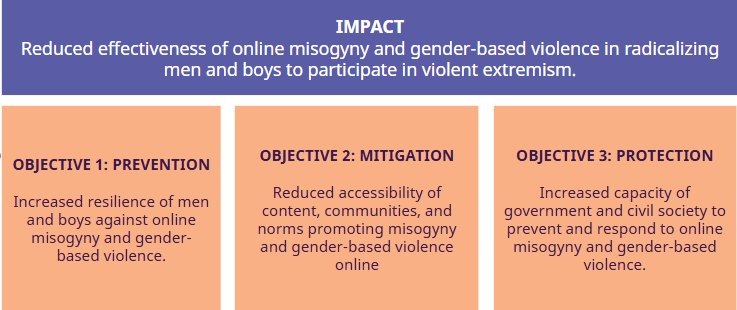
Through community interventions, online inoculations, classifier development, and policy frameworks, Catalyst works to increase resilience against pathways to violence while building the evidence base for what works.
What is Catalyst doing?
- We are presently delivering programs in four languages across four countries:
- Canada (English & French),
- Jordan (Arabic)
- Kenya (Swahili).
- United Kingdom (English).
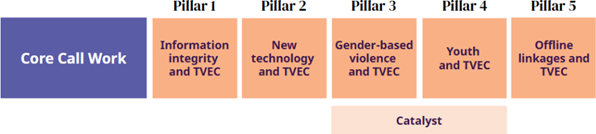
- Together we are pioneering novel ways to prevent violence: from open-source AI detection tools, to gaming safely curricula, peer mentorship programs, a civil servant academy, and a Global Policy Dialogue, all grounded in cutting edge research.
- Our work is amplified through the Catalyst Forum, an impact network convened across governments, platforms, academia, and civil society.
Context: Why Misogyny?
Support for misogyny increases vulnerability to violent extremism. Violent misogyny can also constitute violent extremism and become a motivator for further acts of terrorism.
Misogynistic narratives are also prevalent in terrorist propaganda across the spectrum, from jihadist to Neo-Nazi and violent nihilistic groups, and serves as a driver of radicalisation to violence.
This translates into real world loss of life. Gender-based violence appeared in nearly 40% of terrorist manifestos from 1966-2025 as either the primary or significant secondary motivator for the attack.
Further, individual profiles of terrorists also often reveal past involvement in intimate partner violence.
Misogynistic grievances can become ideological drivers for violent extremist attacks which are not always coded as such: between 34-45% of mass shootings in the US (depending on the year) are motivated by grievances against women.
Despite this, there are few programs directly mitigating the impact of violent misogyny online on violent extremism. We are changing that.
Catalyst and CCF Leadership
The Christchurch Call Foundation provides strategic leadership, technical oversight, coordination, direct implementation of programmes, and convening power for Catalyst.
Through a team of recognized leaders in preventing gender-based violence, violent extremism, and applied tech policy, we chair programme governance, align delivery across pillars and geographies, and ensure that research, tools, and interventions translate into operational practice.
We also lead several specific gaming and policy programme strands. This includes connecting partner outputs to the practical needs of countries, policymakers, practitioners, platforms, and community leaders.
We ensure that Catalyst delivers innovative activities and builds sustained capability globally by providing open-source tools and resources for all to use.
How can you get involved?
- Get in touch to find out more about joining the Catalyst Forum.
- The Forum brings together over 100 members across the world to share new research and prevention strategies, and to develop best policy practices.
- Apply here for the Catalyst Public Policy Champions Programme (Applications closed).
- Led by the Christchurch Call Foundation and delivered by the Hertie School in partnership with the VOX-Pol Institute, this fully funded, international executive-style training is designed for policymakers and practitioners working at the intersection of technology-facilitated gender-based violence and violent extremism.
- Catalyst is designed as both an implementation programme and a rapid pilot programme – this approach supports scalable adoption by partners, platforms, and governments, while strengthening durable multi-stakeholder capability through the Christchurch Call Community. What we find effective, we plan to help scale collectively and globally. Under CCF leadership, Catalyst is positioned to deliver measurable harm-reduction now while ensuring durable capability within partner institutions and the wider Christchurch Call Community via accessible, free resources for changemakers to use.
- To learn more or get in touch the Catalyst team, please contact us.