CCIAO Delphi Study: Building the Governance Foundation for TVEC Algorithmic Research
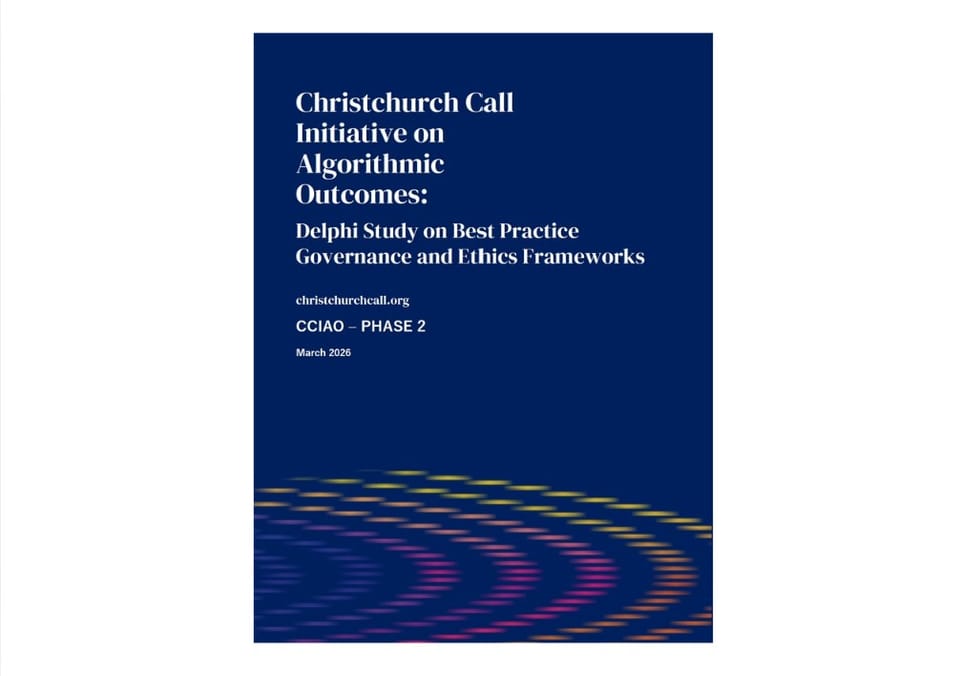
The Christchurch Call Foundation has published the findings of a Delphi Study into governance and ethics frameworks for the Christchurch Call Initiative on Algorithmic Outcomes (CCIAO) — a programme aiming to enable independent research into how algorithmic systems amplify terrorist and violent extremist content (TVEC).
The Challenge
Algorithms determine what billions of people see online. When those systems intersect with terrorist and violent extremist content (TVEC), they can potentially expose users to unfiltered, extreme violence and, in some circumstances, that exposure may contribute to radicalisation to violence. Yet independent, cross-platform research into these dynamics has been prohibitively complex and often limited in scope. The Christchurch Call Initiative on Algorithmic Outcomes (CCIAO) is designed to close that gap.
The Approach
Research of this sensitivity requires governance and ethics frameworks built on genuine multistakeholder consensus. The CCIAO Delphi Study convened 37 experts from 17 countries across government (18%), academia (28%), the Christchurch Call Advisory Network (16%), not-for-profits (15%), the wider Call community (10%), and civil society (5%). Using the Delphi method — an iterative, anonymised survey process — participants refined their thinking across two rounds, with consensus assessed at clearly defined thresholds (80%+ strong, 60–79% moderate).
Across two rounds of the CCIAO Delphi Study, participants achieved consensus on the following:
- The top five values for governance: human rights, transparency, safety by design, harm prevention, and a free and open internet
- A staged, scalable governance model starting with a group of 5–10 members
- Technical expertise as the primary selection criterion, with strong support for policy and cultural diversity
- Proactive conflict-of-interest management with pre-appointment disclosure
- Ethics oversight embedded into project workflows — not bolted on after the fact
Key Findings
The study produced nine recommendations that will guide CCIAO’s governance and ethics architecture:
- Core values: Human rights, transparency, safety by design, harm prevention, and a free, open, and secure internet.
- Governance model: A scalable, multistakeholder advisory group of 5–10 members, expanding as CCIAO develops. Technical expertise as the primary selection criterion, with strong emphasis on policy knowledge and cultural diversity.
- Ethics integration: Continuous ethics oversight embedded into project workflows and milestones — not applied retroactively. Draw upon other reference models.
- Accountability: Merit-based, fixed-term rotating appointments with proactive conflict-of-interest management, pre-appointment disclosure, and independence from funding sources.
- Civil society: Meaningful participation underpinned by clearly defined roles, shared responsibility, and coordinated support.
Where Views Diverged
There were of course some areas of divergence, such as regarding the tension between agility and inclusivity in group size, and whether data providers should sit at the governance table or observe from alongside it.
These divergences are not weaknesses — they reflect the genuine complexity of multistakeholder governance and will inform further thinking.
What’s Next
These findings will serve as a key input as CCIAO moves into Phases 3 and beyond. The aim is that these frameworks will be operationalised alongside data access protocols, researcher accreditation, and further technical development — advancing toward the initiative’s goal of transparent, privacy-preserving research into how algorithms shape online pathways toward and away from TVEC.
Read the full report below: